Modern Study Skills Every American Student Should Know
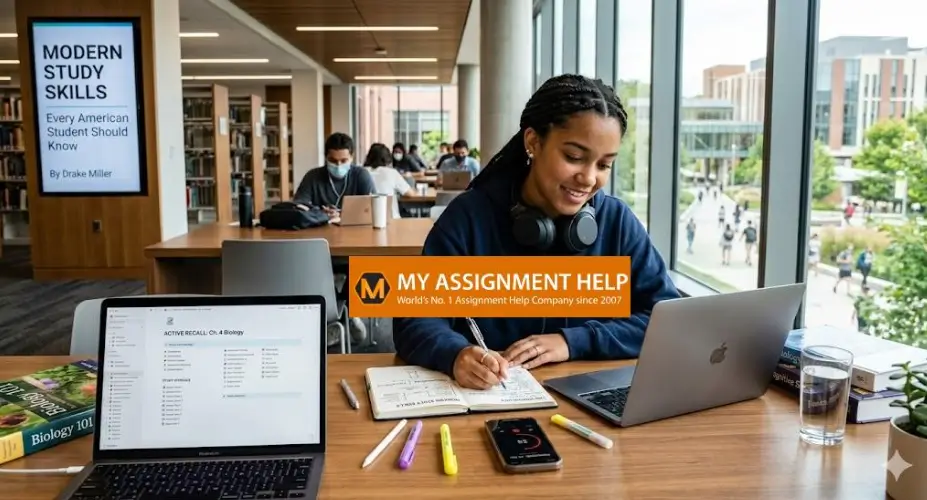
In the fast-paced academic environment of the United States, students from high school through postgraduate studies face a common challenge: the sheer volume of information. Whether you are prepping for the SATs, tackling AP courses, or navigating the rigorous demands of a Master’s degree, the “work harder, not longer” mantra has never been more relevant.
Traditional cramming is not only stressful; it’s scientifically inefficient. To truly excel, American students need to adopt “Smart Study” techniques—methods backed by cognitive science that optimize memory retention and focus. This guide explores evidence-based study methods designed to transform your academic performance and help you reclaim your personal time.
1. The Power of Active Recall
Most students study by re-reading their textbooks or highlighting notes. While this feels productive, it is a passive activity that leads to “the illusion of competence”—you recognize the information, but you haven’t mastered it. Active Recall flips this script. Instead of putting information into your brain, you focus on pulling it out.
How to Implement Active Recall
- The Closed-Book Method: After reading a chapter, close the book and write down every key concept you remember. Don’t look back until you’ve exhausted your memory.
- Flashcards: Use digital tools like Anki or Quizlet. The act of seeing a question and forced-retrieving the answer builds stronger neural connections.
- Pre-Testing: Before diving into a new unit, try taking a practice quiz to identify what you already know and where you need improvement. This approach helps you focus your study sessions more effectively. If managing multiple deadlines at once feels overwhelming, some students choose to use services that let them write my assignment online so they can dedicate more time to active learning and intensive retrieval practice.
Why it works: It forces your brain to retrieve information, strengthening the neural pathways associated with that data. It transforms you from a spectator into an active participant in your education.
2. Spaced Repetition: Beating the Forgetting Curve
Psychologist Hermann Ebbinghaus discovered the “Forgetting Curve,” which shows that we lose roughly 50% of new information within 24 hours unless we actively review it. To combat this, we use Spaced Repetition—reviewing information at increasing intervals (e.g., 1 day later, 3 days later, 1 week later, 1 month later).
The Strategy
- The Leitner System: This uses physical flashcards and boxes. Cards you answer correctly move to a box that is reviewed less frequently; cards you miss stay in the “daily” box.
- Digital SRS: Software like Anki uses algorithms to show you the most difficult cards at the exact moment you are about to forget them.
3. The Pomodoro Technique for Deep Focus
In an era of TikTok and constant notifications, deep focus is a superpower. The Pomodoro Technique is designed to combat burnout and maintain high levels of concentration.
- The Method: Set a timer for 25 minutes of intense, distraction-free work. Follow this with a 5-minute break. After four “Pomodoros,” take a longer 15–30 minute break.
- For High Schoolers: This is perfect for tackling intimidating subjects like Calculus or Physics in manageable chunks.
- For University Students: Use “Double Pomodoros” — 50 minutes of focused work followed by a 10-minute break — when tackling writing-heavy research papers. This method helps you stay productive without feeling mentally drained. If difficult quantitative topics are interrupting your study flow, getting finance homework help at Myassignmenthelp.com can reduce your academic backlog and give you more time to dedicate your Pomodoro sessions to exam preparation and concept revision.
4. The Feynman Technique: Teach to Learn
Named after Nobel Prize-winning physicist Richard Feynman, this technique ensures you truly understand a concept rather than just memorizing jargon. If you can’t explain it simply, you don’t understand it well enough.
- Choose a Concept: Write the name of the topic at the top of a blank sheet of paper.
- Explain it to a Sixth-Grader: Use simple language. Avoid “academic-speak.” Use analogies to describe complex processes.
- Identify the Gaps: When you get stuck, go back to your source material. This is where the real learning happens.
- Review and Simplify: Refine your explanation until it is a brief, elegant narrative.
5. Dual Coding: Combining Words and Visuals
Our brains process images and words through different channels. By using both, you create two different ways for your brain to represent the same information. This creates a “double-track” in your memory.
How to Apply It
- Infographics and Diagrams: When taking notes on Biology, don’t just write “mitochondria is the powerhouse of the cell.” Draw the organelle and label the ATP production sites.
- Mind Mapping: Use mind maps to connect historical events. Visualizing the “web” of causes for the American Civil War is much more effective than a chronological list.
- Timelines: For subjects like History or Literature, visual timelines provide a spatial context that text alone cannot provide.
6. Interleaving: The Secret to Long-Term Mastery
Many students practice “blocked” learning—doing 50 math problems on the same topic back-to-back. While this helps in the short term, Interleaving (mixing different topics or types of problems in one session) is better for long-term mastery.
- The Benefit: It teaches your brain how to choose the right strategy for a problem. On a cumulative final or exams like the GRE, LSAT, or MCAT, the questions aren’t labeled by chapter. Interleaving prepares you for the “randomness” of real exams.
- How to do it: If you are studying for a Chemistry exam, mix problems from Chapter 1, 3, and 5 in the same session rather than mastering them one by one.
7. Optimizing Your Environment and Biology
Smart studying isn’t just about what you do with a book; it’s about how you treat your body and your space.
The “No-Phone” Zone
Research suggests that the mere presence of a smartphone—even if it is turned off and face down—reduces cognitive capacity. The brain has to use energy to ignore the phone. For true Deep Work, put your phone in another room.
Sleep and Memory Consolidation
Sleep is not “down time” for the brain; it is “processing time.” During REM and deep sleep cycles, your brain moves information from short-term storage (the hippocampus) to long-term storage (the neocortex). Pulling an all-nighter can actually lower your GPA because your brain never gets the chance to “save” what you learned.
8. Leveraging Academic Support
Sometimes, even the best techniques aren’t enough when you’re overwhelmed by a heavy credit load. In the American academic system, seeking help is a sign of a high-achieving student.
Utilizing Resources
- Office Hours: Professors in the US value students who engage. It’s the best way to get clarity on complex rubrics.
- Online Specialized Help: For students looking for tailored guidance on complex projects or high-stakes assignments, Myassignmenthelp.com offers expert insights that complement your self-study efforts.
9. Developing Digital Skills in the Academic Framework
As we move through 2026, the way American students interact with information is changing. It is no longer enough to just find information; you must be an “agent” in your own learning.
- Socratic Engagement: Instead of looking for easy answers, use digital resources to quiz yourself or to find the logical flaws in an argument.
- Digital Curation: Use tools like Notion or Obsidian to build a “Second Brain,” organizing your digital notes into a permanent knowledge base.
See also: Advanced Tech Cloud 1274031969 Solutions
10. Frequently Asked Questions
Q.1 How long does it take to see results from these techniques?
You will notice immediate improvements in your daily focus using the Pomodoro technique. However, for memory-based techniques like Spaced Repetition, you will likely see a significant jump in exam performance after 3–4 weeks of consistent application.
Q.2 Can I use the Feynman Technique for math and science?
Absolutely. In fact, it’s one of the best ways to master STEM subjects. Try explaining a complex physics formula or a calculus derivation as if you were explaining the “logic” of a game to a child. If you can’t explain why a step happens, you’ve found your knowledge gap.
Q.3 Is it better to study alone or in a group using these methods?
A hybrid approach works best. Use Active Recall and Spaced Repetition for individual mastery, then use group sessions for the Feynman Technique. Teaching a concept to a peer is the ultimate test of your understanding.
Q.4 How do I manage study fatigue during finals week?
Prioritize your biology. Focus on the “Interleaving” method to keep your brain engaged by switching subjects every 90 minutes, and never sacrifice more than two hours of sleep for extra study time; the cognitive trade-off isn’t worth it.
11. Conclusion
Success in American high schools and universities isn’t about who spends the most hours in the library; it’s about who uses those hours most effectively. By implementing Active Recall, Spaced Repetition, and the Feynman Technique, you shift from being a passive consumer of information to an active master of your curriculum.
About the Author – Drake Miller
I am a dedicated blog author associated with Myassignmenthelp.com, known for creating informative and engaging academic content for students worldwide. I focus on education trends, assignment writing tips, study strategies and student success guides. With a clear and reader-friendly writing style, I help learners understand complex topics while offering practical solutions to improve academic performance and productivity.